What to Do After a Brain Dump: Sort Your Thoughts and Choose One Next Step

 Farid Asadi
The page is full. You can leave most of it for later. Start by finding the commitment that needs a next step.
After a brain dump, scan for real deadlines, separate actions from thoughts to process and ideas to revisit, and choose one concrete next step. Put later commitments somewhere reliable. Keep useful observations available for review. You can finish this pass with most of the original page still untouched.
Quick answer: Read the dump once for time-sensitive commitments. Mark actions, thoughts to process, and ideas to revisit. Pick one action you can actually begin, then give the remaining commitments a reminder or a place in your task system. Leave room to revisit useful thoughts without making them today’s work.
What Should You Do First After a Brain Dump?
Start with a short scan for commitments that cannot wait: an appointment, a promised reply, a deadline, or information someone needs from you. Record those somewhere reliable before doing a deeper review. If nothing needs attention soon, you can pause and return when you have room to decide.
A brain dump gathers whatever is occupying your mind. The next pass asks a narrower question: what needs a decision from me now?
In Masicampo and Baumeister’s research on unfinished goals, making specific plans reduced the interference those goals caused in other tasks. The finding concerns planning, rather than proof that simply writing a long list resolves everything on it.
Apply that distinction to one commitment at a time. “Send Sam the proposal” may need a next step and a reminder. “I feel behind” needs a different kind of attention. You can keep both on the page without giving them the same treatment.
The Three-Way Sort: Actions, Thoughts, and Ideas
Sort a brain dump by what each item needs next. Three loose groups are enough to begin:
- Actions: commitments or practical problems you intend to do something about. Write the next visible step.
- Thoughts to process: feelings, worries, questions, or unresolved experiences. These may need reflection, a conversation, or simply acknowledgment.
- Ideas to revisit: possibilities, observations, and fragments you want to keep available without committing to them now.
Mark the original page with A, T, or I if that helps. Leave repetition and fragments you no longer need alone. An item can fit more than one group: a worry might contain a practical action and a feeling that remains afterward.
Getting Things Done distinguishes capturing material from clarifying what it means. This three-way sort is a simple adaptation for mixed personal notes. You can use it on paper or in an app without building a new filing system.
A Brain Dump, Sorted Line by Line
Imagine it is Wednesday afternoon. You have twenty minutes before a meeting and this on your page:
Sam needs the revised proposal Thursday. Still need Maya’s cost estimate. I feel behind on everything. Newsletter idea: answer the pricing questions customers keep asking. Keep putting off the dentist. Still annoyed about Monday’s meeting. What if next quarter goes badly? I keep starting my day in email and losing the morning.
This is an invented example. Here is how each line could move forward:
| What you wrote | What it needs | A useful destination or next step |
|---|---|---|
| Sam needs the proposal Thursday | Action | Record the deadline and a work block to revise it |
| Need Maya’s cost estimate | Action | Ask Maya for the estimate and when she can send it |
| I feel behind on everything | Thought to process | Keep the feeling; ask later which commitments are actually at risk |
| Newsletter about pricing questions | Idea to revisit | Save it with the customer questions in your newsletter notes |
| Keep putting off the dentist | Action | Add a task to contact the practice during opening hours |
| Still annoyed about Monday’s meeting | Thought to process | Note what bothered you; decide later whether a conversation would help |
| What if next quarter goes badly? | Thought to process | Separate any concrete planning question from the uncertain outcome |
| Email keeps taking my morning | Idea to revisit | Keep the observation for your next weekly planning session |
Your immediate action could be asking Maya for the estimate because it may unblock tomorrow’s proposal. The dentist task gets its own place. The newsletter idea stays available for planning. You have a first move while the rest remains recorded.
How Do You Separate a Task From a Feeling?
A task names something you intend to do. A feeling describes an experience. Ask whether there is a specific action within your control, then preserve any feeling that remains. “I am worried about the proposal” might lead to checking the missing estimate, but completing that check may not settle every concern.
The NHS problem-solving guide distinguishes problems with practical solutions from hypothetical worries. That distinction can help when a brain dump mixes things you can act on with uncertain outcomes.
You can also ask, “Do I want to understand this before deciding what to do?” For the meeting frustration, a few reflective sentences may be useful before choosing whether to raise it with someone.
Our brain dump vs journaling guide explores that shift from capturing to reflection. Give the feeling enough space to be understood without automatically adding another obligation to your task list.
How Do You Choose What to Do First?
Choose from genuine action items using deadlines, consequences, dependencies, and your current capacity. Start with what would matter if it slipped. Then ask whether a small action would unblock something important. Finally, check whether you have the time, tools, information, and energy to begin.
In the worked example, the proposal has a real deadline. The estimate is a dependency. Asking Maya may therefore be a better first move than polishing parts of the document while the missing information remains unresolved.
GTD’s guidance on choosing work considers context, available time, resources, and priorities. You can apply those checks to the actions you extracted rather than ranking every sentence in the dump.
Quick takeaway: Prioritize a brain dump by first separating commitments from other thoughts. Among the actions, look at real deadlines and consequences, what could unblock progress, and what you can do with your current resources. Choose one starting point while keeping the remaining commitments visible in a reliable system.
What Does a Useful Next Action Look Like?
A useful next action describes a behavior you can recognize yourself doing. “Sort my life out” gives you no clear starting point. “Open the proposal and mark the missing cost section” does. Include enough detail that you can begin without making the same decision again.
Try a verb, an object, and a stopping point:
- “Ask Maya when the cost estimate will be ready.”
- “Find the dentist’s booking number.”
- “Draft three answers to the pricing questions customers asked.”
You can stop after the smallest meaningful step. Finding the booking number is useful if that is what currently prevents you from contacting the practice. Avoid adding miniature steps when the action is already easy to start.
This follows GTD’s distinction between a next action and a project requiring several actions. Keep the larger outcome for context, but write down what you will actually do when you return to it.
When Should You Do the Action You Chose?
Do the action now if it fits the time available and deserves your attention. Otherwise, connect it to a realistic time or situation. “If Maya sends the estimate before lunch, I will update the proposal’s cost section after lunch” gives you a clearer cue than “deal with proposal later.”
Gollwitzer and Sheeran’s meta-analysis of implementation intentions examined plans linking a situation with an action. That research supports making the opportunity to act specific; it does not mean a scheduled intention guarantees completion.
Use a calendar for work that needs a time block and a reminder when you need a prompt. If another person is involved, note what you are waiting for and when you will check again.
You have finished planning this item when you know the next action, the condition or time for doing it, and where that commitment will be visible.
What If You Feel More Overwhelmed After Writing?
Pause the sorting if the whole page feels like too much. You can return to one part later. Check whether anything genuinely needs attention before then, record it if necessary, and give yourself permission to close the page. Completing a brain dump does not commit you to resolving its entire contents today.
Try reducing the decision to “what needs to be handled before I next review this?” That might mean setting one reminder, asking someone for information, or choosing a time to return. It can also mean leaving the rest alone for now.
The NHS problem-solving guide recommends working through one solvable problem at a time and allowing time to relax. This article’s sorting method is a practical suggestion you can adjust to your capacity.
If writing repeatedly increases distress or worry is affecting daily life, consider speaking with a qualified professional. A notes workflow can support everyday organization alongside other forms of support.
Where Should the Remaining Commitments Go?
Put later commitments where you manage actions, appointments, and follow-ups. A promise with a deadline needs a reliable prompt or review point. Copying it into a beautifully organized note will not tell you when to act unless your system also supplies a cue.
Gilbert and colleagues’ review of intention offloading examines external tools such as calendars and reminders that support remembering future intentions. The practical application here is to separate storing information from prompting yourself to use it.
For the example, that might mean a calendar block for the proposal, a task to contact the dentist, and a follow-up if Maya has not replied by the agreed time. Keep links to the original notes when their context would help.
There is no need to copy every thought. Move the commitments you intend to keep and let the original dump remain a record. For broader options, see how to organize notes.
How Do You Keep Ideas Useful Without Making Them Tasks?
Give an idea enough context and a route back to the situation where it could help. The newsletter idea can sit beside customer questions and return when you plan a draft. The email observation can stay in your notes until you review how your mornings are going.
Possibilities do not need invented deadlines to justify keeping them. If you are unsure whether an idea matters, leave it available and let later experience help you decide. Add a project name, source link, or short explanation if the original fragment would be hard to understand on its own.
Note resurfacing can bring older material back through deliberate review, links, tags, or automated suggestions. Search works when you remember what you are looking for; review can reveal a useful thought you had forgotten to seek.
When a fresh idea arrives during another activity, use quick capture to preserve it. You can make decisions about it during a later review.
How Do You Know When You Can Stop Sorting?
A finished review can record your next action, the later commitments you have placed somewhere reliable, and the useful thoughts you are keeping for later. This is a suggested stopping point, not a requirement to reduce every dump to three lines.
For the worked example, it might look like this:
- Next: Ask Maya when she can send the estimate.
- Scheduled or recorded: Proposal revision block, Thursday deadline, dentist booking task, and an estimate follow-up if needed.
- Kept for later: Newsletter idea, meeting frustration, and the pattern of starting mornings in email.
You can now close the original page without losing the distinctions you made. The first line gives you something to begin. The second protects commitments. The third leaves room for reflection and ideas to develop.
Quick takeaway: Processing a brain dump can end before every thought is resolved. In this example, one action moves a proposal forward, later commitments have a place, and other thoughts stay available. The goal is a reliable next step and a useful record you can return to.
Where Lightnote Fits
Lightnote is an AI brain dump notebook for thoughts that are messy when captured and useful later. Auto Tagging organizes notes, Live Notes summarize related writing across tags, Daily Insights bring patterns into view, and Weekly Reflection offers a broader look at your week.
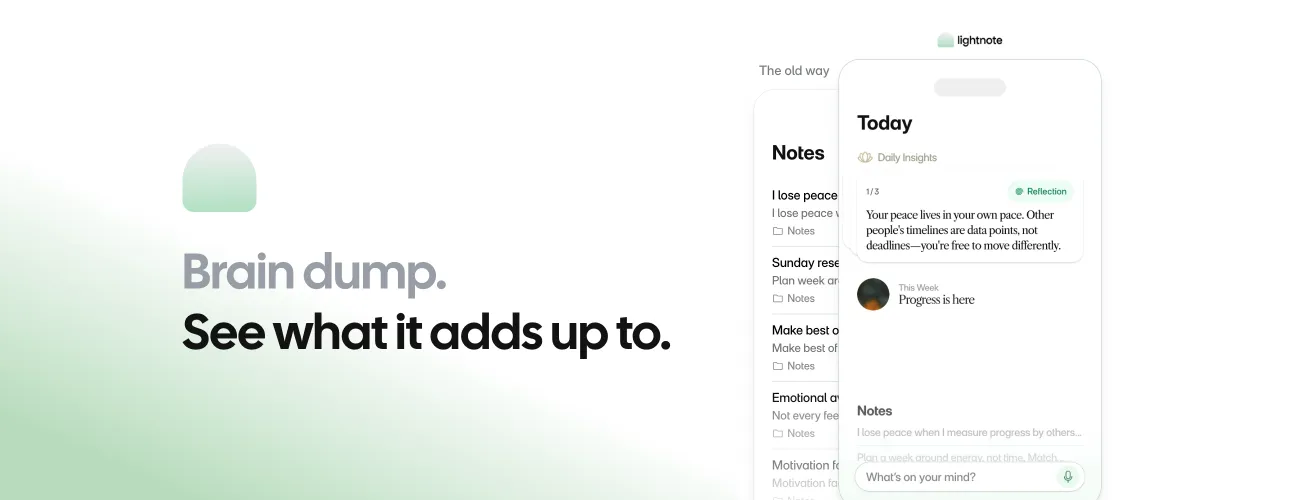
For the example in this article, you would still handle the proposal deadline and dentist appointment in your task or calendar system. You could keep the newsletter fragment, meeting reflection, and morning observation in Lightnote for later review. The product preview shows the interface; these example notes are illustrative.
The useful division is straightforward: make your commitments explicit and keep the rest of your writing available to learn from. You can read about AI note organization to understand what automatic tagging, summaries, and retrieval can contribute.
Open Lightnote, keep your original dump, and choose one thought worth returning to after today’s next action is clear.
Sources
- Masicampo and Baumeister: Plan Making and Unfulfilled Goals (2011)
- Getting Things Done: Capture, Clarify, and Next Actions
- Getting Things Done: Choosing What to Do
- Gollwitzer and Sheeran: Implementation Intentions and Goal Achievement (2006)
- NHS Every Mind Matters: Problem Solving
- Gilbert et al.: Outsourcing Memory to External Tools (2023)
- Lightnote: Auto Tagging, Live Notes, Daily Insights, and Weekly Reflection
Frequently Asked Questions
Scan for real deadlines, then separate actions, thoughts to process, and ideas to revisit. Choose one specific next action and put other commitments in a task or calendar system. Keep useful observations available for later review without turning every line into a task.
Mark each useful line as an action, a thought to process, or an idea to revisit. Use simple letters or symbols on the original page. Move only commitments and material that needs another home; you do not need to rewrite or file the entire dump.
Check actual deadlines and consequences first, then look for something that is blocking another commitment. Choose an action that fits the time, tools, and energy you have. Decide the first step while keeping later commitments recorded somewhere you will see them.
No. A brain dump can contain feelings, worries, observations, possibilities, and commitments. Make a task only when you can name an action you intend to take. Keep useful ideas for later and give feelings room for reflection without automatically turning them into obligations.
A brief scan for time-sensitive commitments can happen immediately. Deeper sorting can wait until you have the capacity. There is no universal rule to wait 24 hours. If you pause, choose a realistic time to return and record anything that cannot wait until then.
Pause instead of forcing yourself to process the whole page. If there is something genuinely time-sensitive, record its next step or reminder. You can return to one part of the dump later. Writing a list does not commit you to solving every item today.
Give commitments reminders or a place in your task system. Keep ideas with enough context to find them around a relevant project. Review recurring themes, use search or tags, or try note resurfacing to bring older thoughts back without relying on memory alone.